


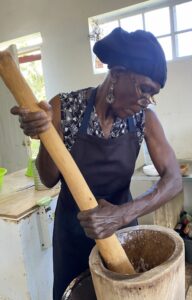
In a quiet kitchen 72-year-old Yvonne Fraser lifts a pestle and brings it down with steady force, pounding yam in a wooden mortar. The movement is rhythmic, deliberate, and powerful—a striking display of strength that has captivated viewers. But for Fraser, it is simply a way of life.
“This is a good form of exercise for the muscles,” she says with a smile. “Look at my muscles—they’re strong… it keeps me going, gives me energy.”
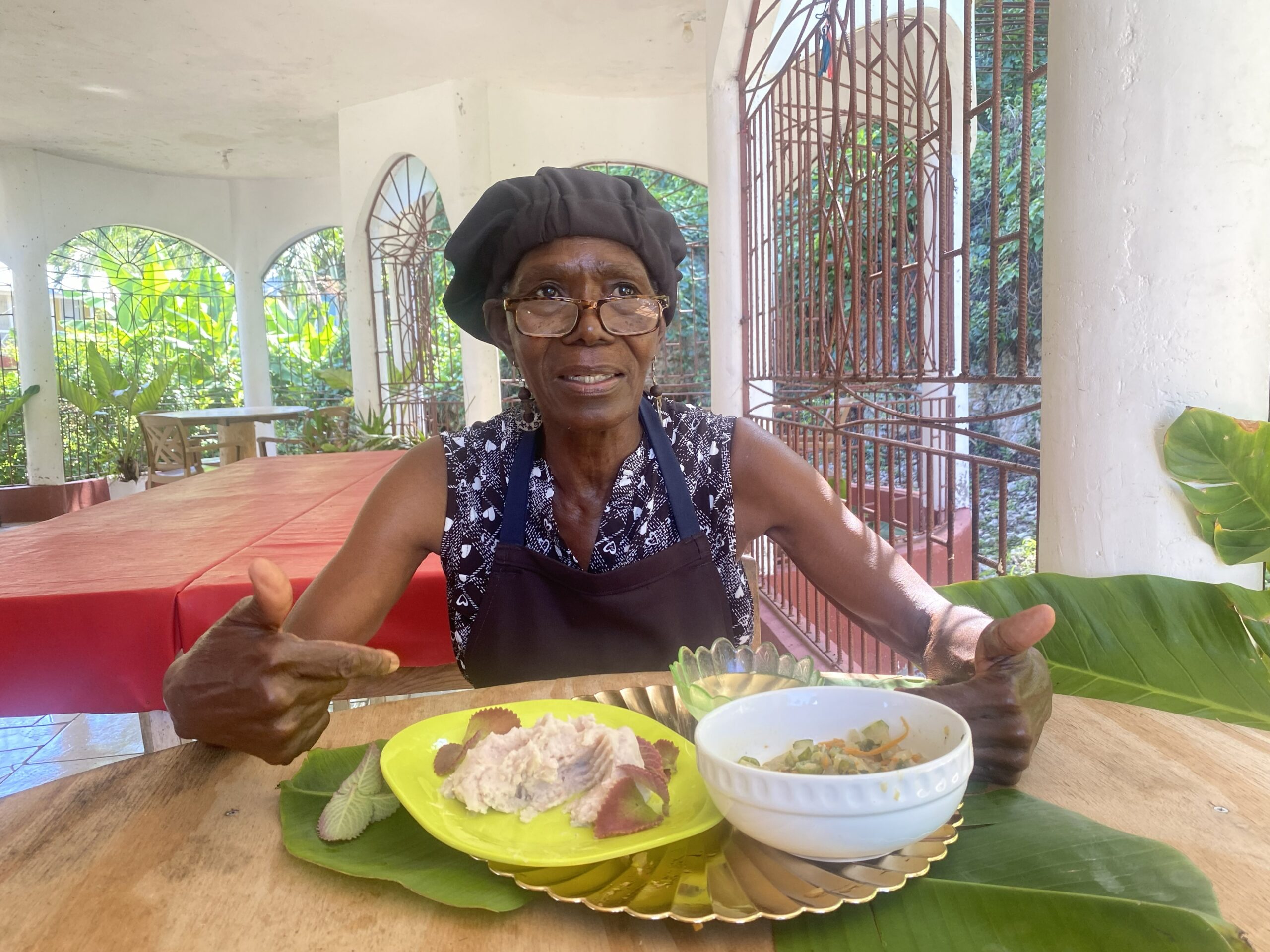
Fraser, a farmer, chef and hospitality trainer, is also a proud descendant of Hanover’s Ettu people, sometimes called the Nago, with ancestral roots in West Africa. Through her, one of the community’s most enduring culinary traditions—fufu—continues to thrive.
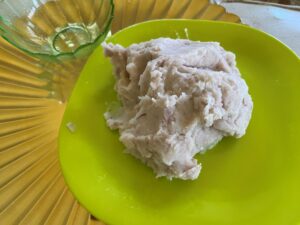
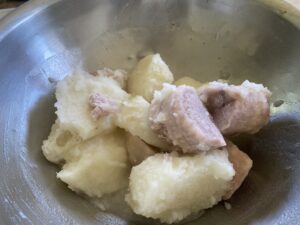
Fufu, a dish widely known across West Africa, takes on a distinctly Jamaican identity in Fraser’s kitchen. Made primarily from yam and the tuber coco, the ingredients are boiled, cooled, and then pounded into a smooth, sticky consistency. The process is labor-intensive, requiring both patience and technique.
“The fufu is basically yam with the coco boiled in a little salt water… then we pound it into a mush which will ball and be served with vegetable,” the Cessnock Hanover native explains as she works.
The pounding, she insists, is essential. While modern appliances might offer shortcuts, Fraser maintains that authenticity lies in the traditional method.
“I don’t know any other way to do it rather than to pound it in the mortar,” she says. “If you put it in a blender, you wouldn’t get the same thing. With the mortar, you don’t add anything—you just boil and then you pound to that smoothness.”
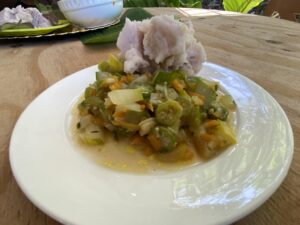
Alongside the fufu, Fraser prepares a vibrant medley of steamed vegetables—okra, carrots, cucumber, onion and thyme—seasoned with natural herbs and spices. The dish reflects not only her culinary expertise but also her deep knowledge of traditional Jamaican healing practices, where food and wellness are closely connected.
“This is the real authentic African fufu,” she says, presenting the finished dish. “And I’m going to have it with some vegetable… a mix of okra… with a little seasoning to flavour.”
For her, the act of preparing fufu is about more than nourishment. It is a link to history, identity and ancestral knowledge. She traces the dish’s origins to West Africa, noting that it was brought to Jamaica by enslaved Africans who carried their food traditions with them.
“The fufu is originally from Guinea… between West Africa and Ghana,” she explains. “The Ettu of Hanover… it was brought to Jamaica by the African people who came over with this dish.”
Though rooted in tradition, fufu is also adaptable. Fraser notes that a variety of ingredients—from plantain to breadfruit to green banana—can be used to create different versions, allowing cooks to innovate while preserving the essence of the dish.
“You can be as creative as you want,” she says. “Anything that you want, you can put it in and create your own style of fufu.”
Yet even as she embraces creativity, Fraser is mindful of what has been lost over time. She recalls a period when every household relied on the mortar and pestle as a central tool of food preparation.
“In the days gone by, every house would have a mortar because this would be their style of preparing their food,” she reflects. “We got modernized and we now move away from these dishes.”
Her message is clear: tradition still has value in a fast-changing world.
“These are healthy foods, and this process is far better than mechanical blending,” she says. “This is just a natural process.”
As she dips the finished fufu into her vegetables, she demonstrates the final step—simple, tactile, and deeply satisfying.
“This is the way it’s done,” she says.
At 72, Yvonne Fraser is not only preserving a culinary practice—she is embodying it, proving that strength, culture and tradition can endure, one pound of yam at a time.